Progress vs Parasites by Douglas Carswell
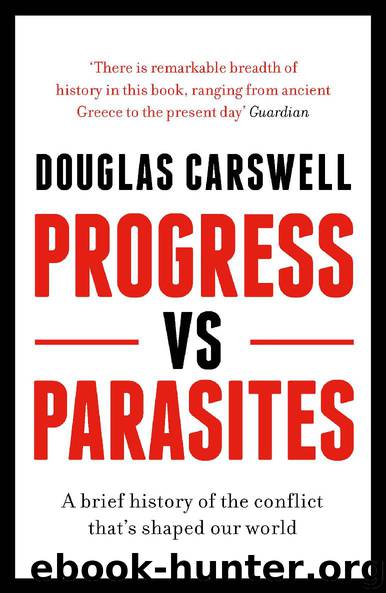
Author:Douglas Carswell [Carswell, Douglas]
Language: eng
Format: epub
ISBN: 9781789542783
Publisher: Head of Zeus
WHY THE DUTCH?
The Dutch flourished because they were free, the productive able to escape the grip of the parasitic. But why were they free? Why was power dispersed in this one particular part of Europe at this time and not in, say, Portugal or Poland?
The Dutch Golden Age cannot simply be explained away as a question of coincidence, the happy confluence of geography (all those waterways) and power politics (defeating Phillip II). Nor is it enough to merely point to the shape of sixteenth- and seventeenth-century Dutch institutions.
The institution of serfdom might well have disappeared from the Dutch countryside, and municipal authorities were strong. Towns did indeed have autonomy over taxes and commercial affairs, while the Stadtholder and States General were kept weak. But all this came about because the old ideas that would have once enabled those with power to use it to extort from the productive had been undermined by new ways of thinking.
As we have seen, when parasitic interests prevail, those at the apex of society are able to order society to their advantage when it is believed that society ought to be ordered. When it is believed that the world and our place in it is part of a celestial order, arranged from on high, we implicitly accept that there should be orders from on high. But in the Netherlands, the notion of a divinely choreographed cosmic order had begun to crumble. This was the great, transformative change that set the Dutch free, for it was what inhibited those that might otherwise inhibit free exchange.
The German priest Martin Luther (1483–1546) had launched a religious revolution – the Reformation – in the early sixteenth century. Luther rejected the idea of a hierarchical Church presiding over a cosmically ordained order. Man’s relationship with God, he proclaimed, is direct, ‘by faith alone’. The Protestant Reformation saw the creation of all sorts of self-governing religious communities across northern Europe, and nowhere more so than in Holland. These were independent from the hierarchy of popes and bishops.
Today, we might make the mistake of assuming that any questions about church governance are merely an ecclesiastical affair. But in the sixteenth and seventeenth centuries there was nothing other-worldly about such matters. They were of profound political importance. If a religious community could govern itself free from priests, then surely other communities could run their own affairs free from princes? And if a society was capable of organizing itself, why have a powerful king in control at all?
Such disruptive ideas swirled across northern Europe. So subversive of the existing order were they, that in Germany, tens of thousands of peasants rose up during the Peasants’ Wars in the early sixteenth century. Unlike the Netherlands, where the Protestant lower orders drove out a Catholic elite, in Germany, the peasant rebellion failed.
If the German sociologist Max Weber is to be believed, the Protestant Reformation is important in explaining intensive economic growth because it brought with it a particular ‘work ethic’. But it’s difficult to believe that any sort of Protestant work ethic can explain why some parts of Europe started to industrialize.
Download
This site does not store any files on its server. We only index and link to content provided by other sites. Please contact the content providers to delete copyright contents if any and email us, we'll remove relevant links or contents immediately.
| Africa | Americas |
| Arctic & Antarctica | Asia |
| Australia & Oceania | Europe |
| Middle East | Russia |
| United States | World |
| Ancient Civilizations | Military |
| Historical Study & Educational Resources |
Cecilia; Or, Memoirs of an Heiress — Volume 1 by Fanny Burney(32558)
Cecilia; Or, Memoirs of an Heiress — Volume 2 by Fanny Burney(31956)
Cecilia; Or, Memoirs of an Heiress — Volume 3 by Fanny Burney(31940)
The Secret History by Donna Tartt(19083)
Sapiens: A Brief History of Humankind by Yuval Noah Harari(14389)
Leonardo da Vinci by Walter Isaacson(13336)
The Radium Girls by Kate Moore(12026)
Sapiens by Yuval Noah Harari(5369)
How Democracies Die by Steven Levitsky & Daniel Ziblatt(5218)
The Wind in My Hair by Masih Alinejad(5095)
Homo Deus: A Brief History of Tomorrow by Yuval Noah Harari(4918)
Endurance: Shackleton's Incredible Voyage by Alfred Lansing(4780)
Man's Search for Meaning by Viktor Frankl(4604)
The Silk Roads by Peter Frankopan(4532)
Millionaire: The Philanderer, Gambler, and Duelist Who Invented Modern Finance by Janet Gleeson(4478)
The Rape of Nanking by Iris Chang(4211)
Joan of Arc by Mary Gordon(4109)
The Motorcycle Diaries by Ernesto Che Guevara(4098)
Stalin by Stephen Kotkin(3965)
